
Patterns, Cycles and Hidden Connections
At a glance. Intimate partner violence (IPV) is abuse by a current or former romantic partner. It often follows a repeating cycle of tension, violence, apology and calm, which is one reason leaving is so hard and so dangerous. Abuse frequently continues after separation, sometimes through the family courts. IPV is also closely linked to sex trafficking: many trafficking victims are exploited by a partner they love. Understanding these patterns helps professionals, families and friends respond with belief and support instead of blame.
Content Note: this page discusses domestic abuse, sexual violence, child abuse, trafficking and suicide threats. Please read at your own pace. Support lines are listed at the end.
Key Terms: DV, IPV and GBV
These three terms are often used as if they mean the same thing, but they don’t.
- Domestic violence (DV) is abuse within a household. It includes abuse between partners, but also between parents and children, between siblings, and by adult children against elderly parents. What defines it is the home setting. An adult son who threatens and financially exploits his elderly mother is committing domestic violence.
- Intimate partner violence (IPV) is abuse within a romantic relationship, whether the partners are married, common-law, dating, separated or divorced. They do not need to live together. Dating violence, abuse by an ex-spouse after separation, and violence in same-sex relationships are all IPV.
- Gender-based violence (GBV) is violence rooted in gender inequality. It targets people because of their gender, gender identity or gender expression, and it keeps unequal power in place. GBV includes IPV, but also sexual assault, sex trafficking, so-called “honour” killings, violence against transgender and gender-diverse people, and workplace sexual harassment.
The terms overlap. When a husband abuses his wife, it is all three at once. But not all domestic violence is IPV (sibling violence, for example), not all IPV is domestic violence (dating partners who live apart), and not all GBV happens at home (street harassment, assault by a stranger).
In Canada, laws, policies and services increasingly use “intimate partner violence” and “gender-based violence” because they are more precise. “Domestic violence” can hide the gendered nature of most partner abuse. This page focuses on IPV that is also GBV: men’s violence against female partners, rooted in power and control. Abuse also happens in same-sex relationships and by women against men, but the great majority of severe, controlling and lethal partner violence is committed by men against women. That reflects wider patterns of gender inequality. IPV is not a “private family matter.” It is a public problem that calls for public solutions.
The Cycle of Abuse
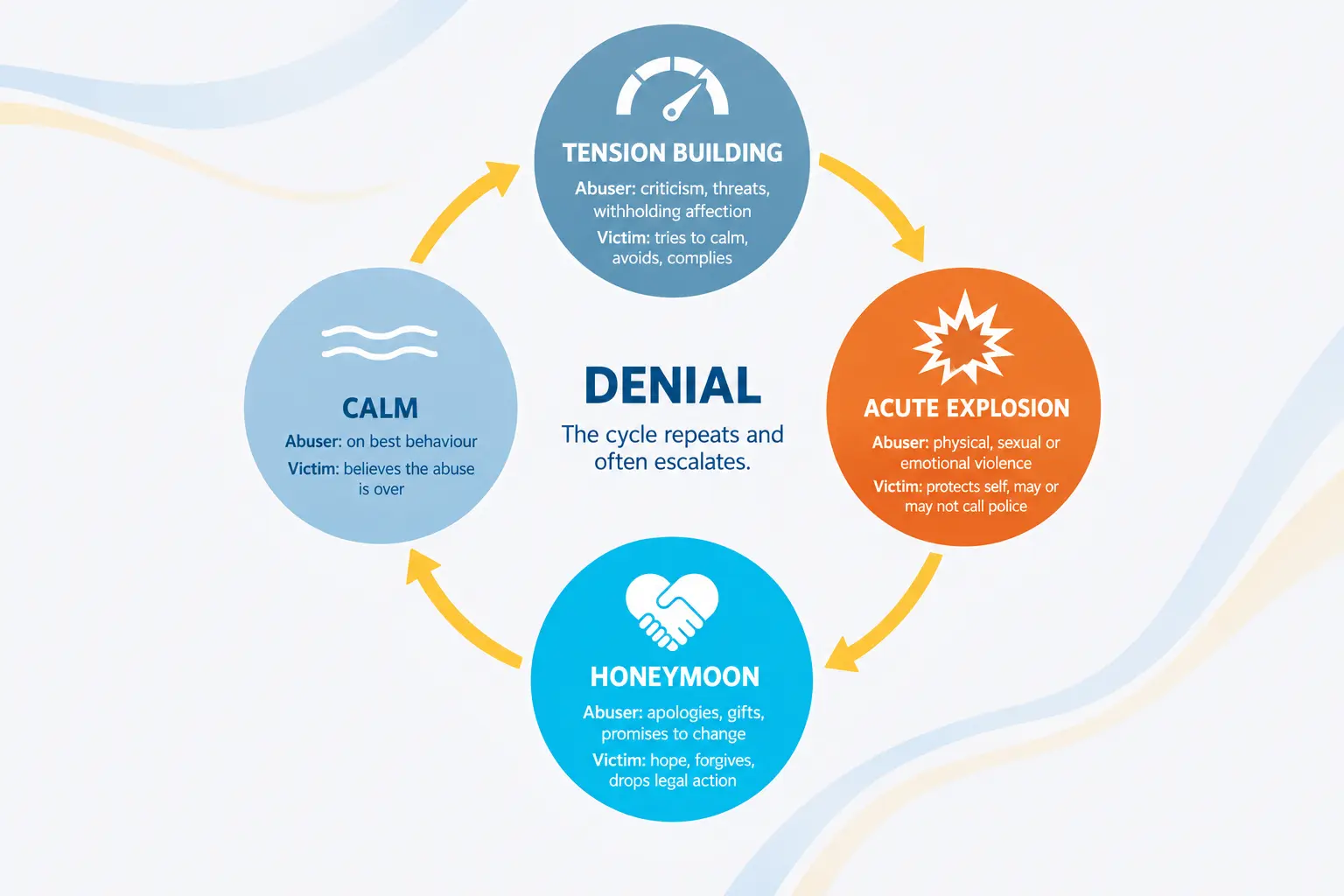
Abusive relationships often follow a pattern known as the cycle of abuse. It repeats again and again, and each round often becomes more intense and more dangerous. The cycle has four phases.
Phase 1: Tension Building
Tension slowly rises. The abuser may lash out at small slights, yell, withhold affection, put the victim down, make threats, accuse her of cheating, claim to be broke while controlling the money, and behave in confusing, “crazy-making” ways. He may also cut her off from others.
The victim works hard to keep the peace. She tries to calm and reason with him, agrees with him to avoid conflict, anticipates his needs and withdraws. Life feels like walking on eggshells.
Phase 2: Explosion
This is when the violence happens. It may be physical, sexual, emotional or psychological: humiliation, slapping, punching, kicking, choking, forced sex, using weapons, throwing objects, stalking, or stopping her from calling for help or leaving. Children may be harassed or abused too.
The abuser denies or downplays what he did. He blames the victim or says he lost control. That denial lets him avoid responsibility and keeps the cycle going.
The victim’s reactions in this moment are about survival. She may try to protect herself, calm him down, call police or flee, or she may not be able to do any of these. Her responses are driven by automatic trauma reactions, not careful choices, because under extreme threat the brain’s survival systems take over from its thinking centre.
Phase 3: Honeymoon
After the violence, the abuser suddenly becomes loving and sorry. He apologizes, promises it will never happen again, blames stress, alcohol or work, and wants to be close all the time. He may promise counselling or spiritual help, enlist family to persuade her to stay, or cry and threaten suicide.
The victim feels relief and hope. The person she fell in love with seems to be back. She may drop charges, arrange counselling for him, forgive him and take him back.
Phase 4: Calm
For a while, things may seem normal or even good. But the calm does not last, and tension begins to build again. Over time, the calm and honeymoon phases often get shorter or disappear, the explosions get worse, and the victim becomes more exhausted, traumatized and trapped.
Why Leaving Is So Hard
The cycle itself creates powerful barriers to leaving.
- Hope. During the honeymoon phase, the victim truly believes he has changed.
- Trauma bonding. Swinging between terror and affection creates an emotional bond that can be even stronger than in a healthy relationship.
- Sunk costs and self-blame. Each time she forgives him, leaving feels harder. She may think, “I’ve given him three chances. Maybe the fourth time he’ll really change.”
- Danger. The most dangerous time for a victim is when she tries to leave. The risk of being killed rises sharply around separation, as the abuser’s need for control can turn lethal. Many victims stay or return because they correctly sense that leaving could put their lives at immediate risk.
None of these reasons are signs of weakness. They are the predictable effects of a pattern designed to keep her in place. Many survivors leave and return several times before they are able to leave for good, and each attempt can teach them something about what support they will need.
So the question should never be “Why doesn’t she just leave?” It should be “What support and resources does she need to get out safely?”
When Abuse Continues After Separation
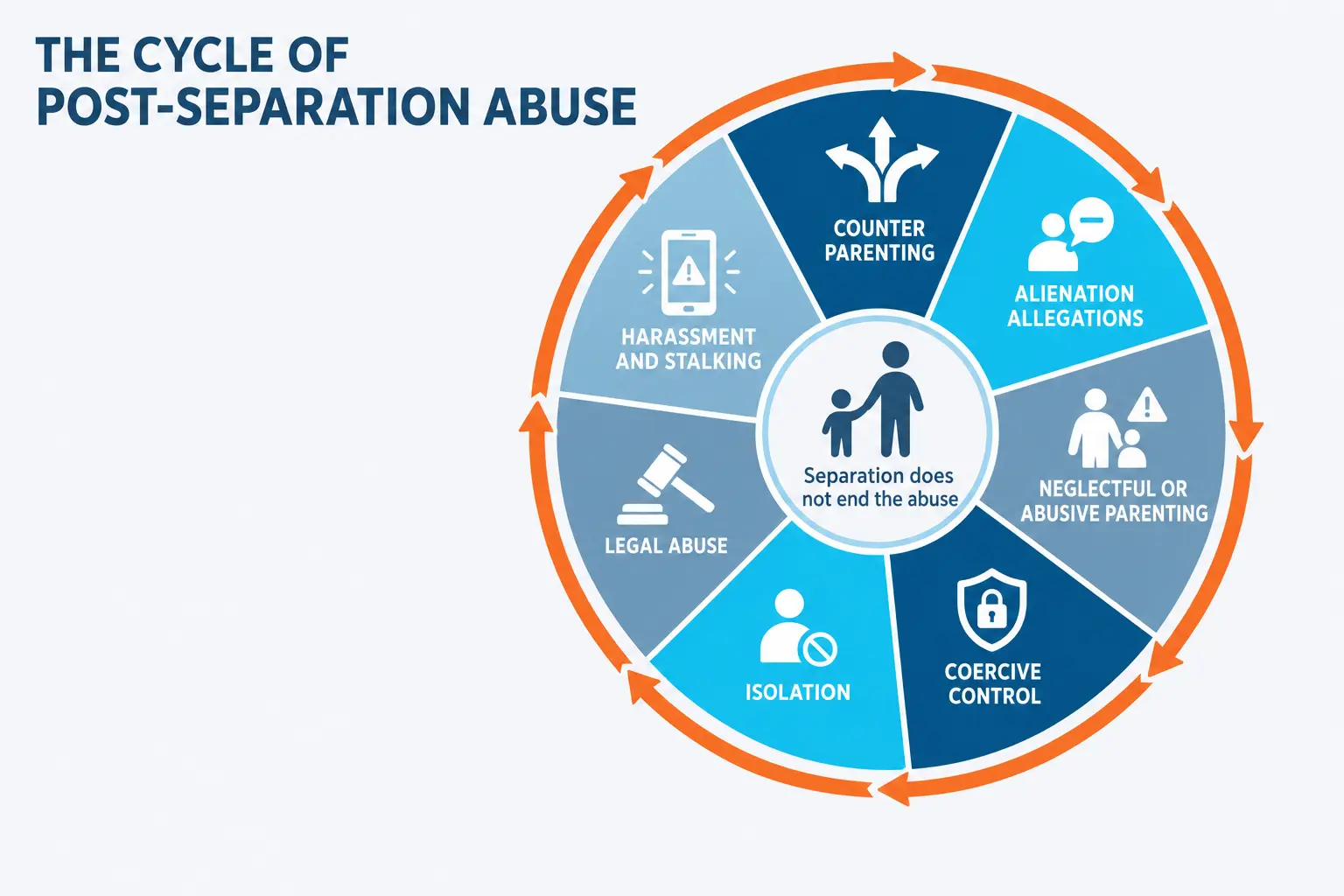
Leaving does not always end the abuse. Often it changes form and becomes post-separation abuse, especially when the couple shares children. It tends to fall into six overlapping categories:
- Counter-parenting. Undermining the safe parent by refusing consent for the child’s medical or therapy needs, blocking access to money, interfering with her job, and withholding or delaying support payments.
- Alienation claims. Falsely accusing the safe parent of turning the child against him. When a child prefers the safe parent for good reasons, those reasons are recast as manipulation.
- Neglectful or abusive parenting. Exposing children to unsafe people or situations, and using threats, intimidation or ridicule to control them.
- Coercive control. Spreading lies to family, teachers and community, turning people against the safe parent, and making her doubt her own memory.
- Isolation. Flooding her with calls, emails and abusive messages designed to wear her down, and cutting her off from support.
- Legal abuse, harassment and stalking. Using the courts to drain her money and energy, ignoring orders, making false reports, seeking custody as revenge, and monitoring her through devices or spyware, often while staying just inside the law.
The misuse of “parental alienation”
Parental alienation theory, made popular by Richard Gardner in the 1980s, claims that one parent, usually the mother, “programs” a child to reject the other parent for no real reason. The theory is widely criticized. It has never been accepted as a valid diagnosis, the World Health Organization did not include it in its ICD-11 classification, and the American Psychological Association has raised concerns about how it is misused.
The theory ignores the many valid reasons a child may reject a parent, including abuse, neglect or fear. In practice, it is used mostly against mothers who report abuse. It can turn a protective parent’s efforts to keep a child safe into “proof” of alienation. Abusers often lay the groundwork during the relationship, by undermining the mother’s parenting, using children as messengers or spies, and threatening, “If you leave, you’ll never see the kids again.”
Warning signs that an alienation claim is being used as a weapon include: the parent making the claim has a history of abuse; the claim appears right after the other parent reports abuse or leaves; the focus is on attacking the other parent rather than on the child; and the claim comes with other tactics such as harassment, financial abuse or endless court filings. Children caught up in these cases may be disbelieved, forced into contact with a parent they fear, and taught that speaking up brings punishment.
The role of family courts
Family courts can become a main channel for post-separation abuse. Many judges, custody evaluators and other court professionals have little training in domestic violence, coercive control or trauma. An abusive parent may come across as calm and reasonable, while a protective mother who is frightened, exhausted and short of money may seem anxious or angry. Her trauma responses can then be read as signs that she is “unstable.”
Courts may also order “reunification therapy” or treat the case as “high conflict,” which suggests both parents share the blame equally. That framing hides who holds the power and who is causing the harm. When the focus is on keeping contact with both parents at all costs, children can end up in the care of the parent they fear.
For police, victim services and child protection workers, the key is to look at the whole history of the relationship. Threats to “take the kids,” and claims that the mother is “turning the kids against me,” are coercive control tactics. Write down what children actually say and do. Investigate abuse reports properly instead of dismissing them as alienation. And remember that a child who rejects a parent may be protecting themselves, not acting out a script.
The Link Between IPV and Sex Trafficking
The same tactics
As described in our page on coercive control, Diana Russell showed in 1982 that the tactics of abusive husbands closely matched Albert Biderman’s chart of methods used to break down prisoners of war.[1][2] Later research found that traffickers use these same methods. Whatever the label, “partner” or “trafficker,” the abuser becomes the most powerful person in the victim’s life. Psychiatrist Judith Herman observed that the methods one person uses to enslave another are strikingly similar across very different settings.[3] These methods do not depend on constant violence. They only require the victim to believe the abuser is capable of it. Threats against loved ones are especially effective. Many abused women say their partner threatened to kill their children, parents or any friend who helped them escape.Partners as traffickers
In Canada, sex trafficking often happens within a romantic relationship. The trafficker may be the victim’s boyfriend or the father of her children. Victims in this situation may love him, be trauma-bonded to him, depend on him for money, have no one else to turn to, fear losing their children, or face threats against their family. Many describe their experience as “an abusive relationship” rather than trafficking, so they may seek help at a women’s shelter rather than an anti-trafficking service.From childhood exposure to exploitation
Growing up with IPV raises the risk of being trafficked as a teen or young adult. The landmark ACE Study by the US Centers for Disease Control and Prevention and Kaiser Permanente found that the more adverse childhood experiences a person had, the greater their risk of a wide range of health, social and behavioural problems later in life.[4] Children who witness IPV may come to see abuse as normal, may struggle to judge who is trustworthy, and may develop survival habits, such as people-pleasing and compliance, that traffickers know how to exploit. The effects of a mother’s trauma can also be passed to her children.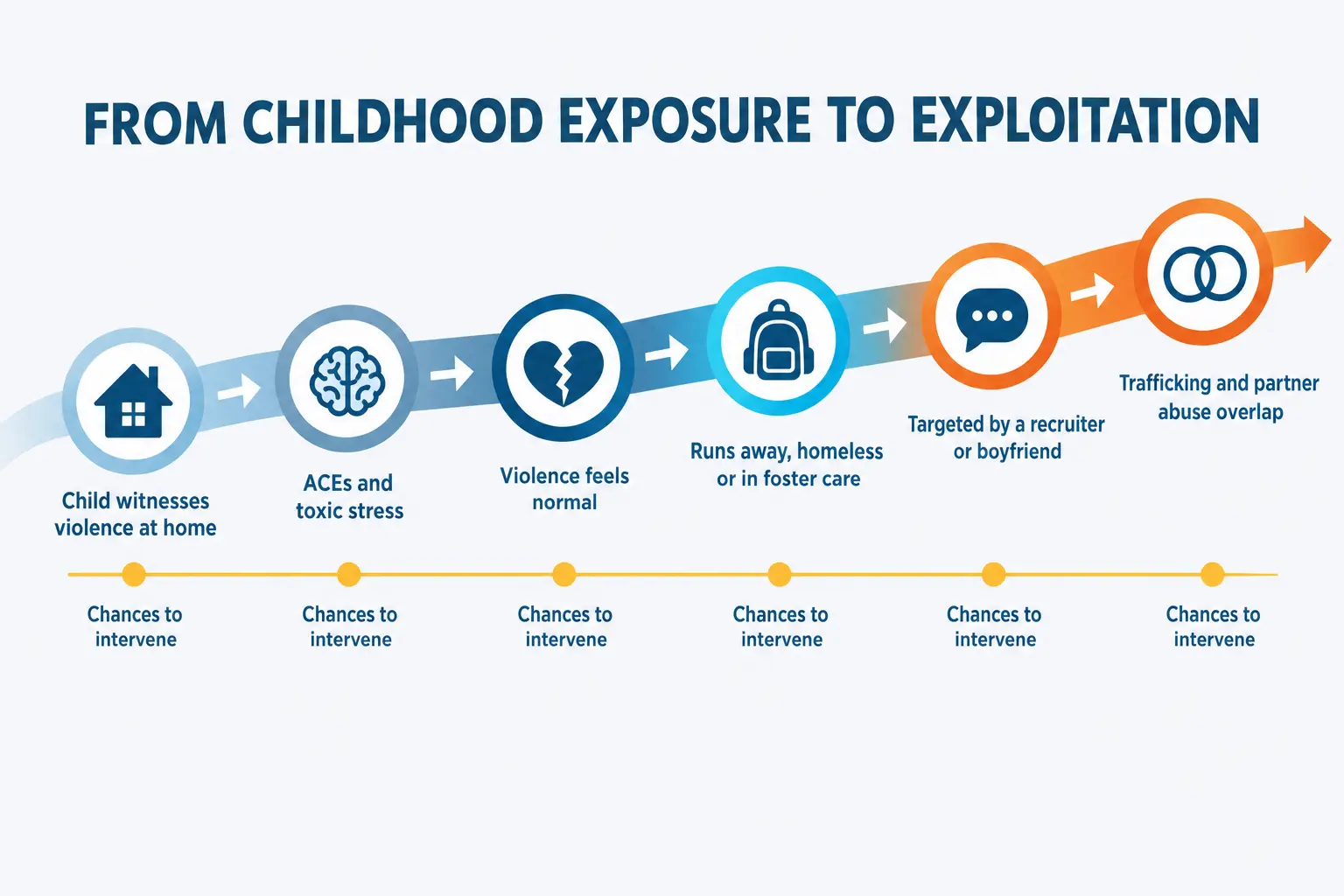
Overlapping groups of victims
Because IPV and trafficking are so closely linked, the same women often appear in both systems:
- IPV survivors trafficked by their partners. An abusive partner may force a woman into prostitution or pornography as a way to control her money, punish her or show that he “owns” her. She may seek help for the violence without mentioning the sexual exploitation.
- Trafficking survivors who later face IPV. Women who leave trafficking remain at higher risk of abusive relationships, because of trauma, money problems, small support networks and survival habits that abusers can exploit.
- Women facing both at once. A woman may be trafficked by her partner while also suffering other forms of abuse from him, or trafficked by someone else while her partner adds to her danger.
What Frontline Workers Can Do
- Screen for both IPV and trafficking. Gently ask how decisions about money are made, whether a partner has ever pressured her into sex with others, and whether anyone controls what she earns.
- Treat disclosure as a process. Victims may share the more “acceptable” parts first and reveal sexual exploitation only once trust grows.
- Don’t force a label. Focus on the harm, the safety needs and the support she wants, not on whether it counts as IPV or trafficking.
- Work across systems. Shelters and anti-trafficking services should train together and refer to each other.
- Recognize coercion in the justice system. Some victims are forced into crimes by abusive partners or traffickers and need protection, not punishment.
- Invest in prevention. Early support for children exposed to violence, healthy relationship education and economic independence for women all reduce long-term risk.
At every step, the principles are the same: believe her, put safety first, respect her choices and offer support without judgment.
Lasting change also requires a shift in culture. When media, advertising and pornography present women mainly as sexual objects, both abusers and traffickers operate in a climate that excuses them. Prevention means media literacy, sex education that covers consent and healthy relationships, public campaigns that challenge acceptance of violence against women, and accountability and treatment for those who cause harm. IPV and sex trafficking sit on the same spectrum of exploitation and control. Seeing them together leads to better help for every survivor.
Where to Get Help in Canada
If this page has brought up difficult feelings, you do not have to face them alone.
- ShelterSafe (sheltersafe.ca): an online map of women’s shelters across Canada, run by Women’s Shelters Canada.
- Canadian Human Trafficking Hotline: 1-833-900-1010, confidential and available 24/7, with online chat.
- Suicide Crisis Helpline: call or text 988, available 24/7.
- Hope for Wellness Help Line (for Indigenous people across Canada): 1-855-242-3310, available 24/7.
- In an emergency, call 911.
References
1. Russell, D. E. H. (1982). Rape in Marriage. Macmillan.
2. Biderman, A. D. (1957). Communist attempts to elicit false confessions from Air Force prisoners of war. Bulletin of the New York Academy of Medicine, 33(9), 616–625.
3. Herman, J. L. (1992). Trauma and Recovery: The Aftermath of Violence—From Domestic Abuse to Political Terror. Basic Books.
4. Felitti VJ, Anda RF, Nordenberg D, Williamson DF, Spitz AM, Edwards V, Koss MP, Marks JS. Relationship of childhood abuse and household dysfunction to many of the leading causes of death in adults. The Adverse Childhood Experiences (ACE) Study. Am J Prev Med. 1998 May;14(4):245-58. doi: 10.1016/s0749-3797(98)00017-8. PMID: 9635069.



Let's Connect
Have a question about our research, training programs, speaking engagements, or opportunities to collaborate? We’d be happy to hear from you.