
The Invisible Chains of Abuse
Coercive control is a pattern of abuse in which one person slowly takes over another person’s life. It works through fear, isolation, humiliation and control of money, time and relationships, often with little or no physical violence. The same tactics have been used on prisoners of war and on the victims of trafficking. They can be used by individuals, and also by institutions. Knowing how coercive control works helps us understand why leaving is so hard, and how to help.
Content Note: This page discusses domestic abuse, sexual violence and torture tactics. Please read at your own pace. Support lines are listed at the end.
"Why Didn't I Leave?"
Many survivors ask themselves why they stayed. To answer that honestly, we need to understand psychological defence mechanisms.
Defence mechanisms work below our awareness. They protect us from painful feelings, such as anxiety, guilt and a sense of worthlessness, that arise when we face a situation we cannot easily escape. In Freudian theory, these defences are natural and normal. They bend our view of reality just enough to help us cope.
Problems start when the defences are used constantly. Under coercive control, a victim may rely on them every day. Over time this can lead to serious conditions such as severe anxiety, depression and post-traumatic stress disorder (PTSD).
The result is a harmful loop. The abuser keeps using coercive tactics, and the victim keeps using defence mechanisms to survive them. The relationship becomes one-sided, with the controlling partner fully in charge. Researchers have compared these tactics to the methods used to break down the minds of hostages, cult members and prisoners of war.[2]
Common defence mechanisms include:
- Repression: The mind keeps upsetting or threatening thoughts out of conscious awareness.
- Denial: The person blocks out what is happening because it is too much to face.
- Projection: The person places their own unacceptable thoughts or feelings onto someone else.
- Displacement: A strong feeling, such as anger, is redirected onto a safer target.
- Regression: Under stress, the person falls back on behaviour from an earlier stage of life.
- Sublimation: A strong feeling is redirected into something socially acceptable.
What Coercive Control Is
Coercive control is a deliberate, ongoing pattern of behaviour. It is not a single incident. Over time it builds what can be described as an architecture of subjugation: invisible chains and a constant sense of dread that seep into every part of a victim’s life.
Abusers who use coercive control work to place their partner under their will in four main ways:
- Violating her body and safety through physical and sexual violence.
- Denying her respect and independence through intimidation.
- Cutting her off from other people through isolation.
- Taking away what she needs to live her own life, such as money, transport, a phone or identity documents.
Much of this abuse is hard to see from the outside. In her award-winning book See What You Made Me Do, Australian investigative journalist Jess Hill explains that a victim’s most terrifying moments may never appear in a police report or be grasped by a judge. She describes domestic abuse as a private language that develops slowly between two people. A sideways glance, a sarcastic tone or a cold silence can leave a victim breathless, because she has learned to read these signals the way an animal senses a coming storm.[1]
Biderman's Chart of Coercion
In 1957, sociologist Albert Biderman studied how Chinese and North Korean captors broke down American prisoners of war.[3] Although his chart came out of the Cold War, Amnesty International later described it as setting out the universal tools of torture and coercion.
In 1982, Diana Russell published her ground-breaking book Rape in Marriage. In it, she placed Biderman’s chart side by side with the common tactics of men who abuse their wives. The two lists were almost exactly the same.[4] Later research has supported her findings.[5]
The chart below shows how each method appears in intimate partner violence (IPV) and how it tends to affect the victim.
1. Isolation
What the abuser does: Cuts her off from friends and family; controls her time, surroundings and money.
How the victim is affected: Without outside support, she becomes completely dependent on him.
2. Monopolizing Her Attention
What the abuser does: Blocks her from working or having outside interests; makes her responsible for his needs; becomes violent when she does something he dislikes.
How the victim is affected: She loses self-esteem, doubts her abilities, and focuses all her energy on keeping him calm.
3. Exhaustion
What the abuser does: Leaves her with most of the housework; drags out arguments or assaults; disrupts her sleep.
How the victim is affected: She becomes too worn out, physically and emotionally, to resist or think clearly.
4. Threats
What the abuser does: Threatens to take or stop supporting the children, hurt or kill her or loved ones, or ruin her reputation; has sudden mood swings.
How the victim is affected: She loses hope that anything will change, stays on high alert, and grows more depressed.
5. Occasional Kindness
What the abuser does: Acts like the person she fell in love with; buys gifts, apologizes, promises counselling.
How the victim is affected: She hopes the abuse is over, starts to doubt it really happened, and relies on him for praise.
6. Showing Total Power
What the abuser does: Reminds her she has nowhere to go and no one to turn to.
How the victim is affected: She accepts that she is powerless and that his behaviour is normal.
7. Degradation
What the abuser does: Insults, belittles, screams, blames, mocks and humiliates her; forces her to do degrading things.
How the victim is affected: Her confidence and self-worth wear away until she loses the will to resist.
8. Petty Demands
What the abuser does: Makes unreasonable demands, such as constant attention or frequent sex.
How the victim is affected: She falls into a habit of obeying and learns to feel helpless.
Coercive Control Does Not End When She Leaves
Leaving an abusive partner does not always end coercive control. For many survivors, especially those who share children with the abuser, it changes shape and continues after separation.
After the relationship ends, an abusive parent may:
- keep up a climate of fear that touches every part of the other parent’s life
- belittle, shame and criticize the safe parent to cause emotional harm
- spread lies and rumours to family, friends, teachers and community members, to damage her reputation and strip away her support
- turn people against her so she is left more alone (sometimes called triangulation)
- push a false version of events until she doubts her own memory and judgment, which is known as gaslighting
- accuse her of the very things he is doing
- limit the child’s time with friends and others, so he stays at the centre of every relationship
Because the abuser no longer has daily access to the victim, these tactics often become more calculated. They may run through family courts, schools and community networks. Recognizing this as ongoing abuse, not ordinary “conflict” between ex-partners, is essential to keeping survivors and their children safe.
The Coercive Cycle
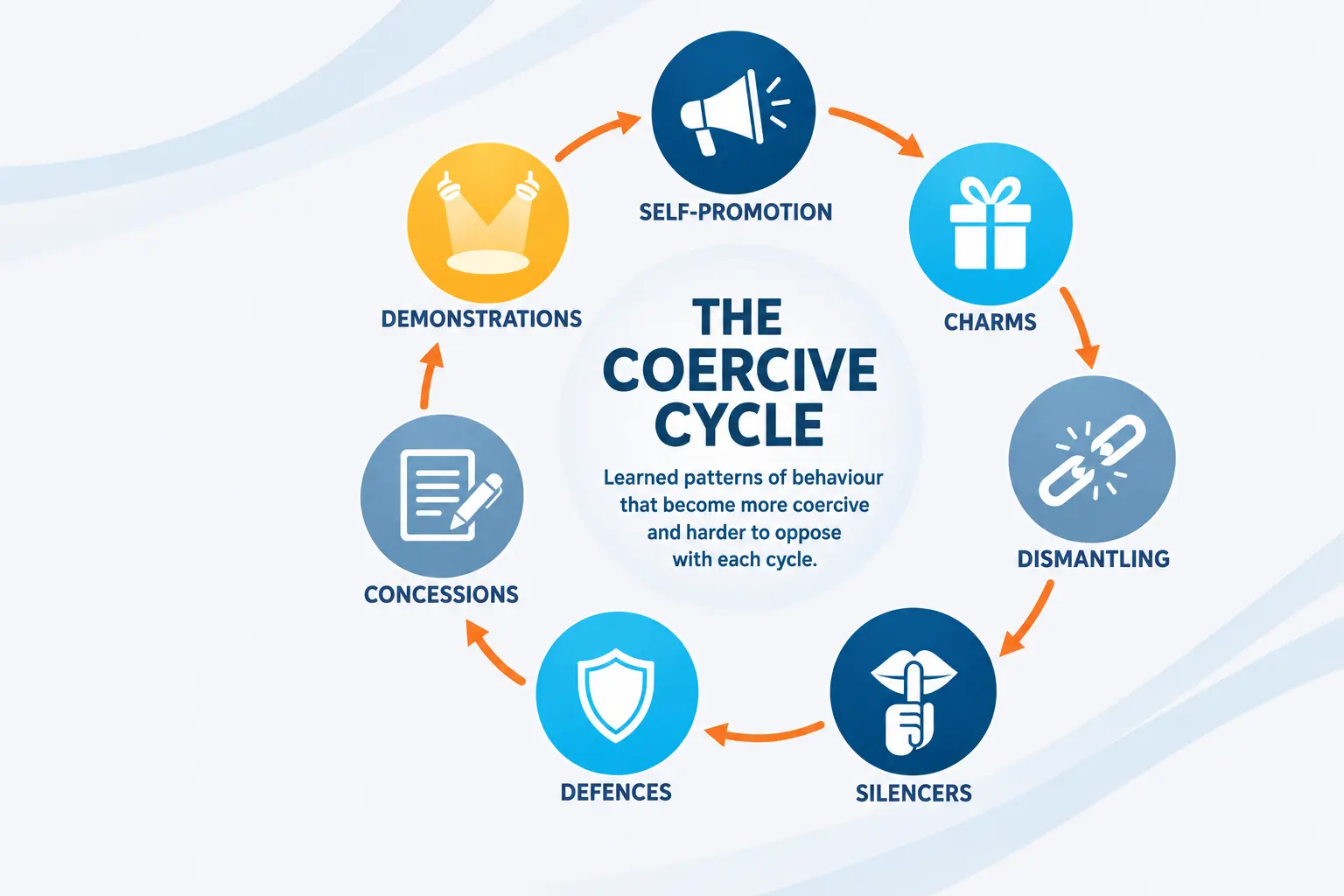
Coercion creates confusion, and confusion makes control easier. Author Wade Mullen draws a useful line between single acts of coercion, such as a flattering remark, a threat, a fake apology or a guilt trip, and patterns of coercion.[6]
When tactics are used again and again, over time and with different people, patterns appear. As the patterns repeat, a cycle forms. The abuser learns what works on whom, so the coercion becomes more effective, harder to spot and more harmful. Both abusive people and abusive institutions can become skilled at this.
Mullen describes the cycle in seven stages. Each stage is a group of tactics. Not every abusive situation includes every stage, and many never get past the silencing stage, because the abuser manages to keep the abuse secret.
1. Self-promotion
Many people who abuse a position of trust first built that trust by promoting themselves. They highlight qualities their audience admires and hide those that would damage their image. Showing off something good becomes a way to hide something bad.
2. Charms
The abuser turns this polished image outward to win people over. Flattery, love-bombing, gifts, favours and over-helping all build trust, so the abuser can take what they want without needing force.
3. Dismantling
Charm may give way to attacks, or exist alongside them. The abuser belittles and shames the victim, wearing down her self-respect, and turns family, friends or co-workers against her. With her inner strength and outer support both weakened, boundaries are crossed and she is easier to isolate and harm.
4. Silencers
The victim now carries the secret of the abuse, while the abuser often remains liked and trusted. To protect that image, the abuser may pressure her into silence with threats, non-disclosure agreements (NDAs) or pleas for sympathy. An abusive leader might act like a fierce lion while he holds power, then like a helpless lamb once he loses it.
5. Defences
If the abuser is confronted or exposed, they may use tactics to escape blame. These include excuses, justifications, comparisons with others, and DARVO: denying the abuse, attacking the person who raised it, and reversing the roles of victim and offender.
6. Concessions
If defences fail, the abuser may admit only what is already known and expect instant forgiveness. They may say something like, “I’ve already said sorry, so what else do you want from me?” The apology is a way to disarm the threat and keep the upper hand. Some step back for a while, hoping time will let them return to old habits.
7. Demonstrations
To repair their image, the abuser puts on a public show of change. They try to win back goodwill without ever facing the truth of what they did. If this works, the cycle starts again, now with new and more creative ways to confuse and control.
When Institutions Use Coercive Control
Coercive control is usually discussed as something that happens between partners. But the same patterns can operate inside organizations. Religious groups, sports bodies, the military, schools, workplaces and even justice systems can become places where coercive control is carried out, enabled or turned against victims.
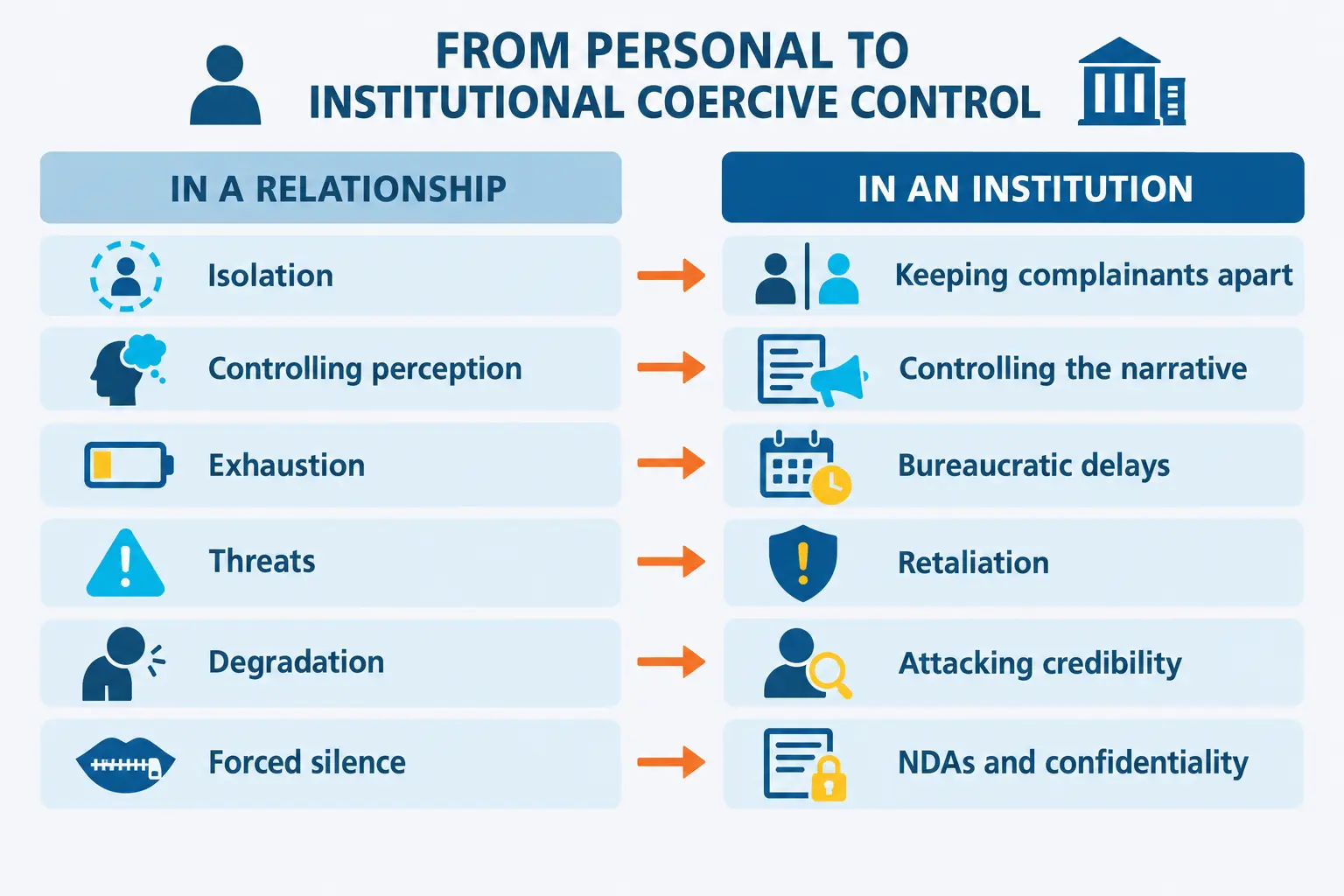
At this level, the tactics in Biderman’s chart are built into the institution’s culture, rules, chain of command and processes. That gives them an air of legitimacy and makes them very hard to challenge. Some of the most common tactics are described below.
Power and Position
Institutions concentrate power. A priest holds spiritual authority, a coach controls an athlete’s career, a commanding officer controls a soldier’s life, and a supervisor controls a worker’s job and references. When someone in authority abuses that power, the victim may feel that challenging them means challenging the whole institution. When victims do speak up, institutions often rally behind the accused, especially if that person brings money, prestige or success.
Complaint Systems That Protect the Institution
Many internal complaint processes are presented as safe for victims but actually serve to contain complaints. A complaint about a coach may go to the director who hired him; a complaint about a priest may go to a bishop who has known him for decades. Investigators may lack training in trauma, approach victims with suspicion, and fail to preserve evidence. These processes happen behind closed doors, and victims are often bound to confidentiality while the institution is not.
Secrecy, Silence and NDAs
Institutions often use privacy, confidentiality and legal privilege to keep abuse hidden. Each victim may be told hers is the only complaint, even when there are several. Settlements usually come with NDAs that buy a victim’s silence. While victims may need the money to recover, NDAs keep victims apart, hide patterns of abuse, leave future victims unwarned, and allow abusers to stay in power. Some parts of Canada have begun to limit NDAs in cases of sexual harassment, assault and discrimination, but they remain widely used.
Reputation Over Safety
When abuse comes to light, institutions often focus on damage control: limiting media coverage, avoiding legal liability and reassuring supporters. Victims are treated as problems to manage rather than people who were harmed. Public statements about “zero tolerance” may be contradicted by private efforts to discredit or wear down the victim.
A Code of Silence
Many institutions expect loyalty above all. Formal rules may forbid “speaking negatively” about the organization. Informal pressure is often stronger: messages like “we handle things internally” or “we protect our own.” In close-knit groups such as military units, sports teams and faith communities, the fear of losing belonging and identity keeps many victims quiet. Members may also be rallied to vouch for the accused and question the victim’s motives.
Exhaustion, Retaliation and Bias
Complicated procedures, long delays and endless appeals wear victims down until they have nothing left for outside options like a lawsuit or a police report. Victims who come forward may face demotion, exclusion, counter-complaints, gossip and isolation. Their credibility is judged against myths about how “real victims” behave, while the accused is given the benefit of the doubt. Institutions may also claim “due process” to justify inaction, setting standards of proof that victims cannot meet.
Institutional Gaslighting
Finally, institutions may tell victims, in many voices at once, that what happened did not happen or did not matter: “That’s not who we are,” “You must have misunderstood,” “You’re overreacting.” Complaints are recast as “misunderstandings” and patterns of abuse as “isolated incidents.” When an entire system denies a person’s experience, she may begin to doubt herself.
Recognizing and Interrupting Coercive Control
For frontline workers, recognizing these dynamics is the first step to interrupting them. Useful questions include:
- Is this process really designed to support victims, or to protect the institution?
- When confidentiality is invoked, who actually benefits from the secrecy?
- Are victims being kept apart so they cannot see a pattern?
- Is “due process” being used to ensure fairness, or to delay and discourage?
- Are credibility judgments based on an understanding of trauma, or on myths?
- Are people who speak up facing retaliation?
Workers who see these patterns have options. They can push for trauma-informed policy changes, support victims through institutional processes while being honest about their limits, connect victims with outside legal and support services, document patterns and call for independent oversight, and, where possible, decline to take part in processes that cause harm.
Whether it happens in a home or in an institution, coercive control relies on secrecy, isolation and confusion. Naming it clearly is one of the most powerful ways to break its hold.
Where to Get Help in Canada
If this page has brought up difficult feelings, you do not have to face them alone.
- Suicide Crisis Helpline: call or text 988, available 24/7.
- ShelterSafe: sheltersafe.ca – an online map of women’s shelters across Canada, run by Women’s Shelters Canada.
- Canadian Human Trafficking Hotline: 1-833-900-1010, confidential and available 24/7, with online chat.
- Hope for Wellness Help Line (for Indigenous people across Canada): 1-855-242-3310, available 24/7.
- In an emergency, call 911.
References
- Hill, J. (2019). See What You Made Me Do: Power, Control and Domestic Abuse. Black Inc., pp. 22–23.
- Stark, E., & Hester, M. (2019). Coercive Control: Update and Review. Violence Against Women, 25(1), 81–104. https://doi.org/10.1177/1077801218816191
- Biderman, A. D. (1957). Communist attempts to elicit false confessions from Air Force prisoners of war. Bulletin of the New York Academy of Medicine, 33(9), 616–625.
- Russell, D. E. H. (1982). Rape in Marriage. Macmillan.
- Silvestri, M., & Crowther-Dowey, C. (2008). Women as victims. In Gender & Crime (pp. 81–108). SAGE Publications Ltd. https://dx.doi.org/10.4135/9781446212721.n4
- Mullen, W. The Coercive Cycle. https://wademullen.substack.com/p/the-coercive-cycle



Let's Connect
Have a question about our research, training programs, speaking engagements, or opportunities to collaborate? We’d be happy to hear from you.