
How It Affects the Brain, the Body and Memory
At a glance. When a person faces extreme fear, the brain’s survival systems take over from its thinking centre. That is why survivors may freeze instead of fighting back, appear calm or even polite during an assault, and later remember events in pieces rather than in order. None of this is a choice, and none of it means a survivor is lying. Understanding the brain science of trauma helps police, lawyers, support workers and loved ones respond in ways that heal rather than harm.
Content Note: this page discusses sexual assault, trafficking and trauma responses. Please read at your own pace. Support lines are listed at the end.
Why the Brain Science Matters
The neurobiology of trauma, meaning how trauma affects the brain and nervous system, explains many common reactions that survivors have. For police in particular, understanding it leads to better interviews, stronger evidence and more successful prosecutions.[1]
It also challenges myths about how survivors “should” behave. People often expect a real victim to fight back, scream, report right away and tell a clear story from start to finish. The science shows why many survivors do none of these things, and why that is normal.
The Thinking Brain Goes Offline
The prefrontal cortex is the part of the brain that handles decisions. It helps us think rationally, plan a response and remember important information.
When a person is facing a traumatic event or extreme fear, the brain’s fear circuitry switches on. As it takes over, the prefrontal cortex starts to work less well, and it may be bypassed entirely.
This means that during a traumatic event, a person cannot think through the situation and make the choices they would make on an ordinary day. It is not a matter of choosing. Their brain is in survival mode.
Three Brain States
It can help to think of the brain as working in three states. Each one asks a different question, and each one needs something different to settle it.
- Survival state (brain stem): “Am I safe?” This is the most basic level of brain function, run by the oldest part of the brain, which controls automatic survival responses. In this state, staying alive comes before thinking or feeling. The only thing that calms the survival state is safety.
- Emotional state (limbic system): “Am I loved?” The limbic system manages emotions and our need for attachment. The only thing that calms an upset emotional state is connection. After trauma, people often move back and forth between the survival and emotional states as they look for both safety and support.
- Executive state (prefrontal cortex): “What can I learn from this?” This is the best state for problem-solving, learning and conscious choice. During trauma, access to it is limited or shut off completely. That is why survivors cannot simply “think their way out” of a trauma response.
For anyone supporting a survivor, this has a practical lesson. A person must feel safe, and then connected, before they can think clearly, answer detailed questions or make plans.
Dissociation: The Brain's Protective Escape
Trauma responses unfold in stages, and later stages often involve some degree of dissociation. Dissociation is a biological protection. It separates a person’s conscious awareness from feelings that are too frightening to bear.
Dissociation exists on a range:
- mild fogginess, sleepiness or trouble concentrating
- feeling numb or cut off from one’s body or surroundings
- out-of-body experiences
- in the most extreme cases, gaps in memory or “lost time”
A survivor who seems flat, distant or oddly calm may be dissociating. This is a survival reflex, not a sign that the event was unimportant to them.
The Seven Trauma Responses
Most people have heard of “fight or flight.” But a wider set of survival responses is now commonly described, often listed as seven: freeze, flight, fight, fright, flag, fawn and faint.
Freeze. The first response to possible danger. Like a deer in headlights, the body automatically turns toward the source of the threat. The goal is to stop, look and listen to work out whether there is danger. The pupils widen. Freeze prepares the body for action and usually lasts only a moment.
Flight and fight. Next, the nervous system mobilizes the body to escape. If escape is impossible, it fights. Blood rushes to the heart and limbs, breathing becomes faster and deeper, the skin turns cold and digestion slows.
Fright. When neither running nor fighting brings safety, fright sets in. It brings panic, dizziness, nausea, light-headedness, tingling and numbness. Psychologists Maggie Schauer and Thomas Elbert describe this stage as one where the body’s “accelerator” and “brake” systems fire in sudden, jerky alternation. The first signs of dissociation appear here.[2]
Flag. If the threat still continues, the body shuts down. This stage brings collapse, helplessness and despair. Moving and speaking become hard, sounds seem far away, vision blurs and numbness spreads. Heart rate and blood pressure may drop quickly. Dissociation is strong in this stage.
Fawn. In the fawn response, a person tries to calm or please the threat. This response is shaped by socialization. Women, for example, are often raised to be polite, agreeable and accommodating. In this state, the person is not making conscious decisions. They are on autopilot, falling back on habits. During a sexual assault, a survivor may comply, say polite things or even smile, but this is not consent. They are terrified, and their brain is running on autopilot to survive. Trafficking victims describe the same kind of disconnection from their bodies during sexual acts with buyers or traffickers. Fawning is not a choice. It is an involuntary survival response.
Faint. The final stage may serve several survival purposes. Lying flat increases blood flow to the brain. Fainting is also linked to disgust, the body’s reaction against something toxic. Schauer and Elbert note that experiencing, or even witnessing, horrific events such as sexual violence can trigger a nerve reaction that leads to nausea, loss of bowel control, vomiting and fainting.[2]
Going limp is not weakness
Some survivors experience extreme reflexes such as tonic immobility, where the body becomes rigid and unable to move, or collapsed immobility, where it goes limp. If you have seen a possum “play dead,” you have seen this reflex. Going limp, feeling sleepy, passing out, or being unable to move or speak are survival mechanisms built into the brain. Even sharks have them. They are not signs of weakness, and they are not choices.
How Trauma Changes Memory
During a traumatic event, memories are stored differently.
- They are not stored in time order.
- There are gaps.
- Whatever the fear circuitry focused on is more likely to be remembered than the background.
For example, a survivor may clearly remember the smell of the attacker’s cologne but nothing about what the room looked like. Details about the setting, such as the layout of a room, and about the order of events are often poorly stored. Again, survivors do not choose what to focus on or remember. It is how the brain works when survival mode takes over.
Memory is affected even more if alcohol or drugs were involved. When someone has been given a so-called “date rape drug,” they may remember nothing at all. In these cases, evidence must come from other sources: a sexual assault evidence kit, blood tests for the drug, video footage, witness interviews and other investigative work.
Four Types of Memory
Trauma does not affect all memory systems equally. There are four main types of memory, grouped into two families.
Explicit memory: what we can consciously recall
- Semantic memory holds general facts, such as knowing what a bicycle is. It draws on several brain areas that combine words, images and sounds into knowledge. Trauma can stop these pieces from joining up, which is why survivors may struggle to put facts about what happened into words.
- Episodic memory is our personal record of events: who was there, what happened and where. Think of remembering who saw you fall off your bike, and on which street. The hippocampus creates and recalls these memories. Trauma can shut it down and break the sequence of events apart. That is why many survivors cannot give a clear, step-by-step account.
Implicit memory: what is stored without awareness
- Emotional memory holds the feelings tied to an experience, like a rush of shame the next time you see the bike you fell from. The amygdala plays a key role. After trauma, a person may suddenly feel intense fear, shame or panic without knowing why, because the emotional memory is intact even when the details are not.
- Procedural memory lets us do familiar tasks without thinking, like riding a bike. The striatum helps create these habits. Trauma can change them. A person may tense up or shift their posture without noticing, which can lead to pain or numbness.
Why Survivors' Stories Come in Pieces
Put together, these effects explain why survivors often cannot give the detailed, chronological account that investigators and courts expect. During the trauma, the hippocampus may shut down, so what happened, when and in what order is not properly stored. Meanwhile, the amygdala stays highly active and records intense emotions.
The result is a survivor who may have powerful emotional and physical reactions but lack clear facts about the sequence of events. They are not being dishonest or evasive. Their brain simply stored the experience differently than it would an ordinary day.
When Stress Becomes Toxic
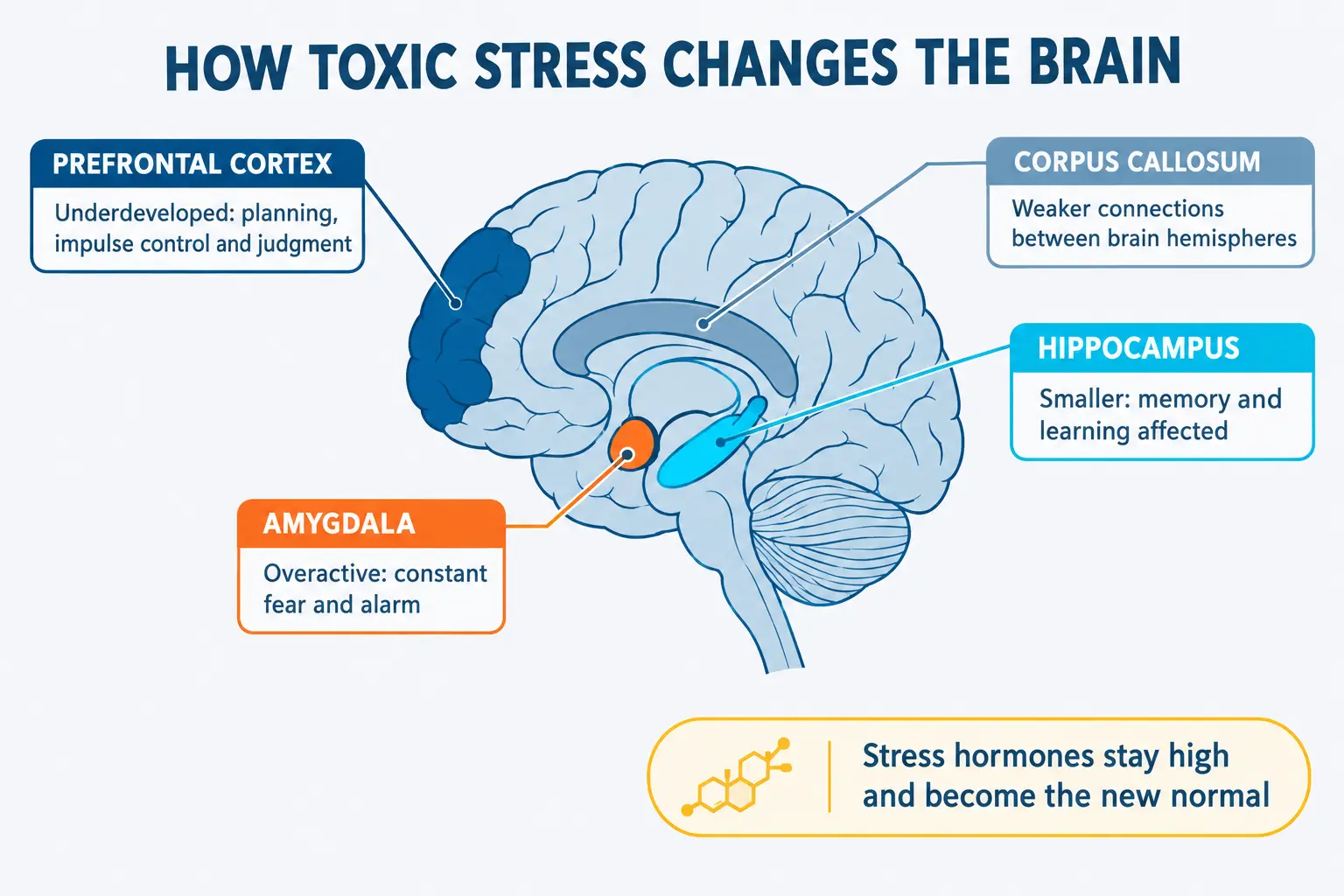
Not all stress is harmful. Brief, mild stress is a normal part of growing up, and even intense stress can be manageable when a caring adult helps a child through it. Stress becomes toxic when a child faces severe, frequent or long-lasting hardship without that support.
Toxic stress during childhood can change how the brain develops:
- The stress system stays switched on. Stress hormones such as cortisol stay high, so being on high alert becomes the body’s normal setting.
- The fear centre grows more reactive. The amygdala becomes overactive, making it harder to tell real danger from imagined danger.
- The memory centre is weakened. The hippocampus may be smaller and work less well, affecting learning and memory.
- The thinking brain develops more slowly. The prefrontal cortex may struggle with impulse control, planning and managing emotions.
- Genes are switched on or off differently. These epigenetic changes can affect stress, immunity and mental health, and some may be passed to the next generation.
Trauma Adds Up Over a Lifetime
Trauma rarely happens just once. Researchers have extended the idea of Adverse Childhood Experiences into adulthood. One assessment of Adverse Adulthood Experiences covers ten hardships after age 21, including partner abuse, sexual assault, living with someone with addiction or mental illness, being a victim of crime, homelessness, frequent money problems, discrimination and imprisonment.
People with many childhood adversities are much more likely to face adult adversities too. Each of the ten adult experiences is linked to poorer physical and mental health, and partner violence has an especially strong link. When childhood and adult trauma are added together, some women carry an enormous load. That load affects their health, their parenting, their finances and their risk of further exploitation. Seeing the whole picture helps explain a survivor’s reactions with compassion instead of judgment.
Trauma-Informed Interviewing
Traditional interviewing methods aim to catch lies and build timelines. With trauma survivors, they often backfire. They assume a person can access their memories fully and in order, which trauma makes impossible. When survivors can’t give the “expected” answers, they are often disbelieved or blamed.
Guidance from the International Association of Chiefs of Police recommends a different approach.[3] At the start, the interviewer can let the victim know that some questions may seem unusual and that every question is meant to help them understand the victim’s experience. Victims should be invited to ask questions at any point. Opening by asking the victim where they would like to begin, or what they feel able to share, sets a supportive tone and lets them describe events, thoughts and feelings in their own words. Those words are valuable evidence.
Other trauma-informed practices include:
- Normalize fragmented memory. Explain early on that memories of trauma are often out of order or incomplete, and that this is how the brain responds to trauma, not a sign that their account is wrong.
- Let the story come in any order. Help piece together the timeline later with gentle follow-up questions about what came before or after.
- Avoid “why” questions. Asking why someone didn’t fight back, scream or report sooner implies blame. Instead, ask what they felt able to do, what was going through their mind, and what led them to come forward now.
- Remember that fight is only one of seven responses. Many survivors freeze, flag or fawn.
- Avoid words that suggest choice. Phrases like “you decided to” can deepen self-blame. Ask what happened next instead.
- Ask about the senses. What someone saw, heard, smelled or felt is often easier to recall than a narrative.
- Don’t assume emotions. Some survivors feel numb or surprisingly calm because of dissociation. Ask how they felt rather than telling them.
- Offer breaks often and explain why any difficult question is necessary.
This approach helps everyone. Survivors feel heard rather than re-traumatized, investigators gather more accurate information, and cases are stronger because the evidence fits the science rather than myths.
Healing Happens Together
Trauma does not have to be the end of the story. In her landmark book Trauma and Recovery, psychiatrist Judith Herman explains that recovery is both personal and political. It can only happen through relationships, never in isolation. And those relationships sit within a wider community whose response can either support a survivor’s healing or undermine it.[4]
The brain is not fixed. Just as trauma can change how it works, safety, steady relationships and good support can help it recover. Many survivors go on to rebuild full, meaningful lives, especially when the people around them understand what they have been through.
Every professional, friend and family member is part of that community. Believing survivors, being patient with fragmented memories and putting safety first can make a real difference to how someone recovers.
Where to Get Help in Canada
If this page has brought up difficult feelings, you do not have to face them alone.
- Suicide Crisis Helpline: call or text 988, available 24/7.
- ShelterSafe (sheltersafe.ca): an online map of women’s shelters across Canada, run by Women’s Shelters Canada.
- Canadian Human Trafficking Hotline: 1-833-900-1010, confidential and available 24/7, with online chat.
- Hope for Wellness Help Line (for Indigenous people across Canada): 1-855-242-3310, available 24/7.
- In an emergency, call 911.
References
- University of Northern Colorado, Assault Survivors Advocacy Program. Neurobiology of Trauma. https://www.unco.edu/assault-survivors-advocacy-program/learn_more/neurobiology_of_trauma.aspx
- Schauer, M., & Elbert, T. (2010). Dissociation following traumatic stress: Etiology and treatment. Zeitschrift für Psychologie / Journal of Psychology, 218(2), 109–127. https://doi.org/10.1027/0044-3409/a000018
- International Association of Chiefs of Police. Successful Trauma Informed Victim Interviewing. https://www.theiacp.org/sites/default/files/2020-06/Final%20Design%20Successful%20Trauma%20Informed%20Victim%20Interviewing.pdf
- Herman, J. L. (1992). Trauma and Recovery: The Aftermath of Violence—From Domestic Abuse to Political Terror. Basic Books.



Let's Connect
Have a question about our research, training programs, speaking engagements, or opportunities to collaborate? We’d be happy to hear from you.